



The Representatives of the NB-ITTAS implementing countries and some regional institutions convened for a Regional Workshop on Governance Mechanism for Cooperation on Conjunctive Water Resources Management (CWM) from 10th to 11th December 2025 at the Rockview Hotel Royale, Wuse II, Abuja, Nigeria, organized by the United Nations Educational, Scientific and Cultural Organization (UNESCO).
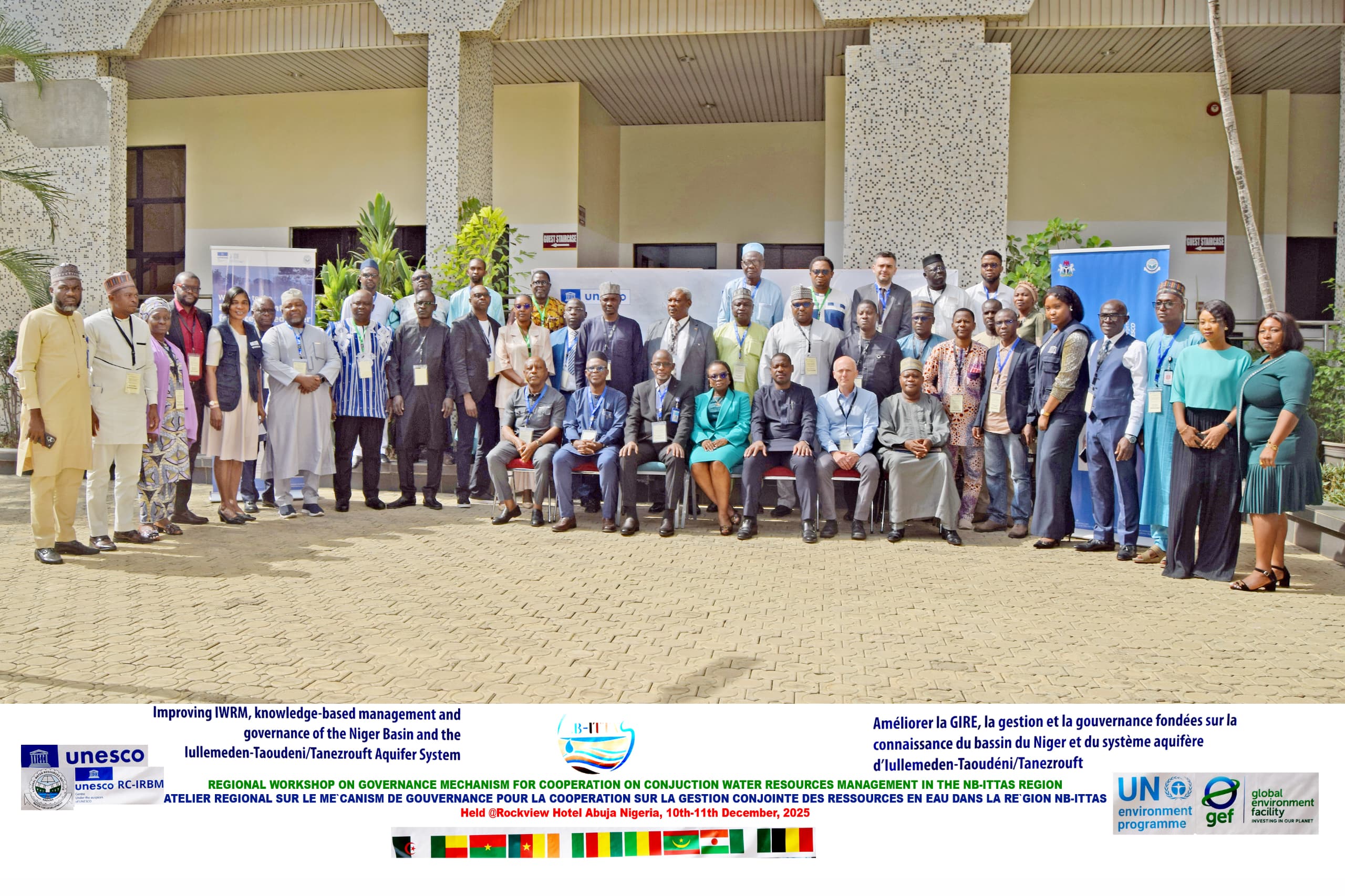
The regional workshop was part of Component 4 of the GEF-Project (2019–2025), titled
“Improving IWRM, knowledge-based management and governance of the Niger Basin and the Iullemeden-Taoudeni/Tanezrouft Aquifer System (NB-ITTAS)” aimed at improving knowledgebased management, governance and resource conservation of the Niger River Basin and the Iullemeden-Taoudeni/Tanezrouft Aquifers (ITTAS), to support Integrated Water Resources Management (IWRM) for the benefit of communities and the resilience of ecosystems.
This workshop was organized by UNESCO through its Regional Centre for Integrated River Basin Management (RC-IRBM) based in Kaduna, Nigeria, and provided an opportunity to strengthen mutual understanding of CWM and to advance collective reflections on enhanced cooperation within the NB-ITTAS region on CWM.
The opening of this two-day regional workshop was placed under the chairmanship of Prof. Joseph Terumlum Utsev, the Honorable Minister of Water Resources and Sanitation of Nigeria, ably represented by the Permanent Secretary of the Ministry Dr. Emanso Okop Umobong, and with the participation of representatives from Niger Basin Authority Executive Secretariat in the persons of Mr. Bachir Tanimoun Alkali and M. Walter Bamidele Olatunji. Also in attendance were the NBA-National Focal Structures from Benin, Burkina Faso, Cameroon, Côte d’Ivoire, Guinea, Mali, Niger, Nigeria and Chad, as well as other key stakeholders such as the OSS and GEFUNEP.
At the end of the regional workshop, the participants and technical partners were able to review progress achieved, identify some gaps and needs, and discuss future opportunities for cooperation and reaffirmed the relevance of CWM as an integrated approach to address hydrological, environmental, and socio-economic challenges in the region.
They confirmed a shared understanding of the key dimensions of CWM including both planning aspects—such as interactions between surface water and groundwater—and field-level applications, notably managed aquifer recharge, protection of groundwater-dependent ecosystems, and water quality considerations.
In conclusion, the participants in the workshop also expressed their commitment to promote the CWM approach, to support its progressive implementation and to mobilize the necessary resources in line with national priorities.